
Politics
FG should stop rehabilitating repentant Boko Haram terrorists, says Senate

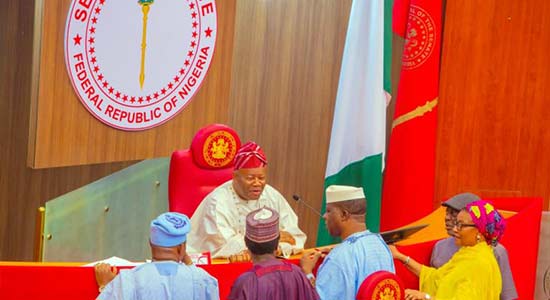
The Senate has appealed to the federal government to stop its rehabilitation programme for repentant Boko Haram members as a result of the abduction and killing of military officers.
This has been done following the inclusion of another prayer that was made on Tuesday while debating about the security situation in the country.
According to Joseph Ikpea, senator representing Edo central, the prayer was included as a voice vote in the consideration of a motion on increasing attacks, abductions, and killings of military personnel.
Adams Oshiomhole, senator representing Edo north, has supported the proposal saying that: “It doesn’t even make common sense to pardon and rehabilitate criminals”.
The motion that was proposed by Abdulaziz Yar’Adua, senator representing Katsina central, has been introduced due to the abduction and death of Rabe Abubakar, retired major general and director of defence information.
Abubakar passed away in captivity after being abducted together with his wife in Katsina state.
Leading the debate during Tuesday’s plenary, Yar’Adua described the country’s security situation as a “national emergency”.
He said insecurity had assumed “increasingly complex, persistent and alarming dimensions”, manifesting through terrorism, insurgency, banditry, kidnapping, violent attacks on communities and the destruction of livelihoods across several parts of the country.
“The death of the retired Major General and others in the custody of terrorists represents not only personal tragedies but also a painful national loss and a stark reminder of the scale and persistence of insecurity confronting the nation,” he said.
Yar’Adua said terrorists had become increasingly sophisticated and emboldened, extending their attacks beyond civilian communities to serving and retired military officers.
“The increasing frequency with which serving and retired military personnel are being targeted by criminal and terrorist groups represents a dangerous evolution in the nation’s security challenges,” he said.
The senator warned that attacks on current and former military personnel undermine the morale of security agencies, weaken public confidence in the state’s ability to provide security and embolden criminal groups.
He listed a series of attacks on senior military officers, including the abduction of Rabiu Garba Yandoto, a retired colonel, in Zamfara in January 2023; the kidnap and killing of Richard Duru, retired major general, in Imo in September 2023 despite the payment of ransom; the murder of Uwem Udokwere, retired brigadier general, in Abuja in June 2024; the abduction of Maharazu Tsiga, former NYSC director-general, in Katsina in February 2025; the death of Joe Ajayi, a retired major, in captivity in Kogi in May 2025; the abduction and rescue of Joseph Ajanaku, a retired colonel, in Plateau in January 2026.
Seconding the motion, Osita Izunaso, senator representing Imo west, urged security agencies to ensure those responsible for the attacks were arrested.
“We have to mandate them to ensure that these people are arrested because we are all following the incident. The perpetrators must be arrested and brought to book,” he said.
Abba Moro, senate minority leader, said insecurity had made travelling unsafe even for public office holders.
“It’s becoming increasingly dangerous for people, even like us that are protected by government, to move around the roads these days,” Moro said.
He recounted the killing of a professor near a police checkpoint in Benue state.
“They just shot him dead right there, very close to a police checkpoint. If people can conveniently be killed like that, then it becomes increasingly scary that we are all walking corpses,” he said.
Moro urged the senate leadership to meet with President Bola Tinubu to brief him on lawmakers’ concerns over the security situation.
Abdul Ningi, senator representing Bauchi central, questioned why criminal groups were controlling parts of the country.
“Is this country at war? If we are not at war, why are non-government bodies controlling parts of this country?” Ningi asked.
He also called for an investigation into the number of security personnel killed across the country and the support available to their families.
Responding to the debate, Jibrin Barau, the deputy senate president, defended the efforts of the armed forces and other security agencies.
“Our men in uniform are doing their best. They are working very hard,” Barau said.
He added that terrorism and banditry had become regional challenges affecting several West African countries.
“The issue of banditry and terrorism has a global dimension. The entire West African region is confronted with this sad reality, from Mali to Burkina Faso, Niger and beyond,” he said.
The senate also urged security and intelligence agencies to strengthen intelligence gathering, intelligence sharing, surveillance operations, threat assessment mechanisms and early warning systems.
Lawmakers called for deeper collaboration with local communities, traditional institutions and religious leaders to improve community-based intelligence and trust-driven security partnerships.
The upper legislative chamber further urged the federal government to accelerate the deployment of modern security technologies, including unmanned aerial systems, geospatial intelligence capabilities, integrated command and control platforms and advanced communications systems to combat terrorism, banditry and kidnapping.
Lawmakers also mandated the senate leadership to constitute a delegation to visit the family of the late Abubakar, the Katsina state government and the Nigerian Army to convey the condolences of the senate.

NDLEA officer drowns while chasing drug suspect into Delta river

Nwifuru sacks Ebonyi commissioner for works, Stanley Mbam

Tension as gunmen attack Plateau market, kill 3

FG names Deji Adeyanju, Buhari, others on panel to probe NSCDC custody deaths

Tinubu may skip UN General Assembly in New York, fresh details emerge

Court of Appeal reverses Lokoja judgment, upholds NDC registration

Atiku to Tinubu: Don’t be ashamed, adopt my idea to cut petrol prices

‘Every Nigerian’s life matters’ — Tinubu directs investigation into miners’ deaths

Woman, 4 children burnt to death in Rivers house fire

Borno: Troops thwart attacks, eliminate four terrorists

Lagos: Several rescued as multiple vehicles collide on Otedola Bridge

2027 Elections: INEC begins Ad Hoc staff recruitment

Lagos APC unveils 2027 campaign council, names Sanwo-Olu, Fashola, Ambode, Gbajabiamila

FAAC shares N2.338tn August revenue among FG, States, LGs

Why Aisha Buhari visited me, Atiku reveals

Toyin Abraham distances herself from APC 2027 campaign list
Tinubu: I did not submit fake NYSC certificate to INEC

Nigerian Army rescues 22 kidnap victims in Niger

Nigerian Army opens 92 Regular recruits intake recruitment