
News
FG launches unified crypto framework as Tinubu signs executive order

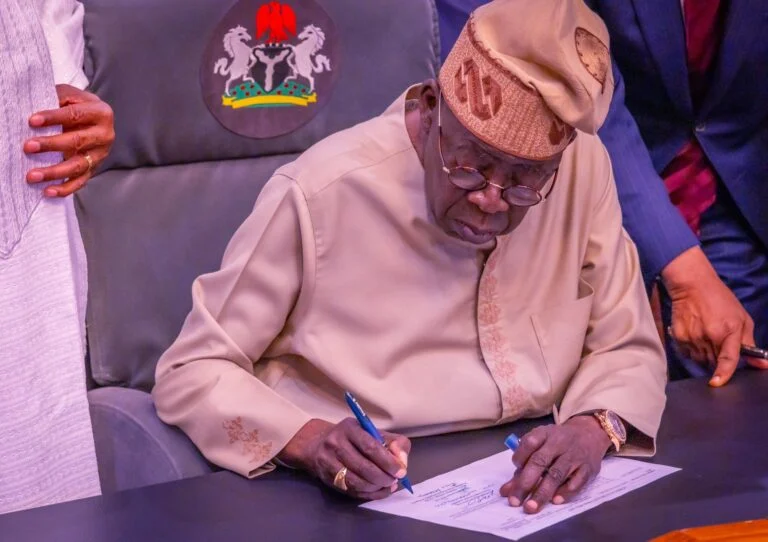
Nigeria’s President, Bola Ahmed Tinubu, has signed an Executive Order on Virtual Assets Coordination, 2026, establishing an entirely new structure for coordinating virtual asset regulation in Nigeria.
The Executive Order, which was signed under Section 5 of the 1999 Constitution (amended), comes into immediate effect, and is expected to ensure increased oversight over the growing ecosystem of virtual assets in the country.
This was announced in a statement by the Special Adviser to the President on Information and Strategy, Bayo Onanuga, on Friday.
As indicated by the Presidency, the executive order aims to address the gaps in regulations which have left room for unscrupulous actors to take advantage of innocent Nigerians while ensuring that the country reaps the benefits of the innovative digital economy.
The statement stated that the fast-paced nature of the development of virtual assets has made the distinction between currency, money, commodity, and securities indistinct and led to fragmentation in regulation across various relevant agencies.
It said further that the lack of coherent coordination has exposed the country to money laundering, terrorist financing, cyber-crimes, data privacy breach, and other financial risks including massive losses of revenues.
“Too often, unregistered and fraudulent operators have exploited these gaps to prey on unsuspecting Nigerians, costing families their savings,” the statement said.
To address the challenges, the Executive Order establishes a Virtual Asset Council to be chaired by the Central Bank of Nigeria (CBN), with the Nigeria Revenue Service (NRS) and the Securities and Exchange Commission (SEC) serving as vice-chairmen.
Other members of the council include the Nigerian Financial Intelligence Unit (NFIU) and the Office of the National Security Adviser (ONSA).
The council will provide policy direction, promote inter-agency collaboration and work with the Attorney-General of the Federation to develop a harmonised legal and institutional framework aligned with Nigeria’s economic, security and social objectives.
The order also creates a Virtual Asset Office, which will serve as the council’s operational arm, with its secretariat domiciled at the Central Bank of Nigeria.
According to the Presidency, the office will coordinate information sharing, regulatory applications and reporting among participating agencies through an integrated supervisory technology platform while allowing each agency to retain ownership and control of its data.
The Federal Government clarified that the Executive Order does not establish a new regulator or transfer statutory powers from existing agencies.
“Each institution retains its full statutory mandate and independence, and the framework coordinates their work rather than replacing it,” the statement said.
Under the new framework, virtual asset activities classified as securities will be regulated and registered by the Securities and Exchange Commission, while payment, settlement, custody and other services involving non-security virtual assets will fall under the regulatory supervision of the Central Bank of Nigeria.
Where there is uncertainty over regulatory responsibility, the Virtual Asset Council will determine the appropriate agency, preventing regulatory loopholes previously exploited by unregistered operators.
The Presidency also disclosed that the CBN is proceeding with plans to establish a regulatory sandbox for virtual assets.
The sandbox will provide a controlled environment where eligible operators can test blockchain-based products and virtual asset services under regulatory supervision before they are introduced into the wider market.
According to the statement, the arrangement will enable regulators to evaluate the impact of emerging technologies on monetary sovereignty, financial stability, consumer protection, financial inclusion, market integrity and government revenue.
The CBN is expected to release further details of the sandbox in due course.
In addition, the Nigeria Revenue Service will introduce a dedicated tax policy for the virtual assets industry to provide greater certainty for taxpayers and service providers while improving voluntary tax compliance.
The Federal Government also revealed that it is finalising a comprehensive Virtual Assets White Paper, which will outline Nigeria’s long-term policy direction and implementation strategy for the sector.
Furthermore, the newly established Virtual Asset Council has been directed to produce a Harmonised Implementation Framework within 30 days to ensure the immediate execution of the Executive Order.
Nigeria remains one of the world’s leading countries in cryptocurrency adoption by transaction volume.
While the Central Bank prohibited banks from facilitating cryptocurrency transactions in 2021, effectively driving trading underground, it reversed the policy in 2023 by introducing a regulatory framework for virtual asset service providers.
The Securities and Exchange Commission has also continued efforts to bring digital asset exchanges under formal regulatory oversight

Court of Appeal reverses Lokoja judgment, upholds NDC registration

Atiku to Tinubu: Don’t be ashamed, adopt my idea to cut petrol prices

‘Every Nigerian’s life matters’ — Tinubu directs investigation into miners’ deaths

Woman, 4 children burnt to death in Rivers house fire

Borno: Troops thwart attacks, eliminate four terrorists

October 1: Tinubu to address Nigerians as FG announces low-key independence celebration

Nigerian Army opens 92 Regular recruits intake recruitment

2027 Elections: INEC begins Ad Hoc staff recruitment

Illegal Mining: FG suspends NSCDC Commandant in Niger State

Toyin Abraham distances herself from APC 2027 campaign list

Benue: Troops rescue seven kidnap victims from criminal hideout

NAF acquires 5 new helicopters to boost security operations

Lagos: Several rescued as multiple vehicles collide on Otedola Bridge

Nollywood Veteran Olu Jacobs dies at 84

Workers shut Education Ministry entrance, demand Alaussa’s removal

Anambra govt releases records of alleged unpaid debts incurred under Peter Obi

2023: Only 6 of 19 Northern governors supported Tinubu, says Shettima

Three vigilantes die in fresh attack in Plateau community

First Lady Remi Tinubu gifts N20m to Qur’anic competition winner
