
News
South Africans hit the streets as anti-immigrant deadline ends

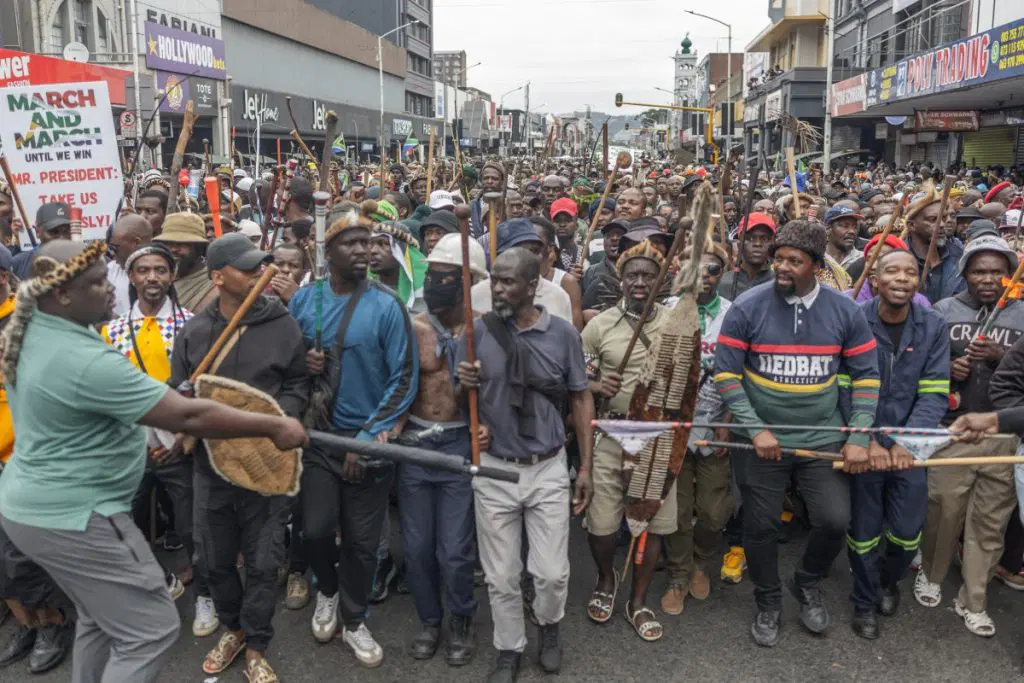
Thousands took to the streets Tuesday in South African cities calling for the expulsion of undocumented immigrants in the wake of a weeks-long campaign that has forced thousands to flee and left four dead.
The national protests came amid a campaign of demonstrations organized by civilian vigilante groups who gave an unofficial June 30 deadline for undocumented immigrants to leave.
There were reports of scattered incidents of looting, stone throwing, and clashes, including near Johannesburg, where a few undocumented foreigners were escorted by security forces from the scene by a crowd wielding heavy sticks.
Marchers paraded through the center of the city, the financial hub of South Africa, where all shops were closed, workers stayed away and transport services were shut down.
They carried flags and banners while police in bulletproof jackets and riot gear kept watch on them.
In the southeastern city of Durban, the traditional homeland of Zulu culture, demonstrators turned up in warriors’ outfits carrying spears, whips, and shields and wearing leopard skin.
Brightness Gumbi, 48, one of the protesters said she was unhappy that she could not rent space to open her own business since foreigners had been opening their own businesses.
“The illegal foreigners manage to pay it because they sell drugs to our people,” she told AFP. “I hope through these demonstrations our president will hear our cries and enforce stricter laws.”
In tourist magnet Cape Town, only about 100 people joined a march through the city centre, passing a counterprotest against Afrophobia and xenophobia.
One of the continent’s wealthiest countries, South Africa, is a magnet for migrant labour while grappling with an unemployment rate above 30 percent, high crime and a breakdown in services in many areas.
Groups mobilising against illegal immigrants say they take jobs and services from locals, claims that analysts say is unfairly scapegoating foreign nationals for government failures.
“South Africans have been replaced by illegal foreigners, increasing unemployment,” the leader of the anti-immigrant March and March group, Jacinta Ngobese-Zuma, told a crowd in Durban.
“We want mass deportation,” she said. “For the next six months we want the government to get rid of the people who have not left.”
At least two Mozambicans, an Ethiopian and a Malawian have been killed in the latest outburst of anti-immigrant violence, according to police.
Several African governments — including Nigeria, Malawi, Ghana, Zimbabwe and Mozambique — have organised voluntary repatriation flights and buses for their citizens.
South Africa has seen previous flare-up of violence targeting undocumented foreign nationals, but this is the first time governments have simultaneously organised repatriations.
More than 25,000 people had been processed for departure in recent weeks, authorities said Monday.
As the protests unfolded in several cities, hundreds of migrants — mostly Malawians and Zimbabweans — gathered in Cape Town, Johannesburg and other centres, waiting for assistance to go home.
Some said their landlords had evicted them or their employers had fired them, fearing fines from officials or attacks by vigilante groups.
“The people in South Africa, they don’t want us here. I’m scared,” said a 23-year-old Zimbabwean woman, who asked to remain anonymous, where around 2,000 people were waiting for buses.
Only a few dozen Malawians remained at a site in Durban from where several thousand had been bused out in recent days, either taken back to their country or to a processing site near the border with Zimbabwe.
“I thought I could stay on but neighbours warned us last night,” 32-year-old Adam John told AFP. “I felt that it is better to try and get home while I still can.”
Concerned about a repeat of unrest five years ago when around 350 people were killed in days of looting and riots, the government put in place a massive security deployment for Tuesday’s mobilisation.
President Cyril Ramaphosa announced stepped-up government plans to combat illegal immigration and called on traditional leaders to use their “standing to calm tensions”.
Coming ahead of local government elections in November, the anti-migrant push has been “politically weaponised”, labour analyst Dale McKinley said.
Previous anti-foreigner riots in South Africa have proved deadly. In 2008, violence left 62 people dead.

Woman, 4 children burnt to death in Rivers house fire

Borno: Troops thwart attacks, eliminate four terrorists

October 1: Tinubu to address Nigerians as FG announces low-key independence celebration

Nigerian Army opens 92 Regular recruits intake recruitment

2027 Elections: INEC begins Ad Hoc staff recruitment

Illegal Mining: FG suspends NSCDC Commandant in Niger State

Toyin Abraham distances herself from APC 2027 campaign list

2027: Obi-Kwankwaso Movement names 59-member Presidential Campaign council

Taraba mining pit collapse leaves 20 feared dead, trapped

Tinubu directs 180-day plan for digital free zones initiative

Workers shut Education Ministry entrance, demand Alaussa’s removal

Benue: Troops rescue seven kidnap victims from criminal hideout

Nollywood Veteran Olu Jacobs dies at 84

Three vigilantes die in fresh attack in Plateau community

Anambra govt releases records of alleged unpaid debts incurred under Peter Obi

Lagos: Several rescued as multiple vehicles collide on Otedola Bridge

NNPCL increases petrol price to N1,430 per litre

2023: Only 6 of 19 Northern governors supported Tinubu, says Shettima

NAF acquires 5 new helicopters to boost security operations
